Gets
Environment & sustainability
Travelling Together. Moving Efficiently.
Travelling by coach means sharing the journey with many other passengers. Sharing a vehicle enables the efficient use of energy and available capacity and can significantly reduce greenhouse gas emissions per passenger-kilometre compared to individual car journeys.
Data from the Austrian Environment Agency (Umweltbundesamt Österreich) illustrates the average difference:
- In 2024, coaches carried an average of 18.81 passengers, compared to 1.13 passengers per car.*
According to the Austrian Environment Agency, an average diesel coach generates approximately 34.6 grams of CO₂ equivalents per passenger-kilometre during operation, compared to 136.7 grams for the average passenger car.*
- This represents approximately 75% fewer direct greenhouse gas emissions per passenger-kilometre.
Modern Coach Fleet and Current Emission Standards
BLAGUSS continuously invests in modernising its coach fleet. All our coaches comply with the European Euro VI emission standard.
When renewing our fleet, we focus on modern vehicle and propulsion technologies as well as the latest emission standards. Thanks to our regular fleet renewal programme, the average age of our coaches is currently just 1.58 years at Blaguss Reisen GmbH and 2.21 years across the Blaguss Group.**
**As of October 2026 | Internal fleet data, Blaguss Group
Emissions Comparison by Mode of Transport*
| mode of transport - Emissions based on average passenger occupancy and capacity utilisation (g/passenger-km) | CO₂-equivalent | CO₂ | NOx |
|---|---|---|---|
| Coach (D) | 34,6 | 33,2 | 0,10 |
| Public bus (D inkl. E) | 40,1 | 37,9 | 0,05 |
| Average passenger car (incl. BEV) | 136,7 | 135 | 0,34 |
| passenger car (D) | 149,3 | 146,8 | 0,54 |
Passenger-km = passenger-kilometre; CO₂ equivalents (CO₂e) = the combined climate impact of different greenhouse gases; NOₓ = nitrogen oxides; BEV = battery electric vehicle. All figures represent direct emissions in grams per passenger-kilometre.
Source: Austrian Environment Agency (Umweltbundesamt Österreich), Emission Factors, 2024 Data Basis, updated May 2026, “Emission Factors per Passenger-Kilometre”.
Austrian Environment Agency – Emission Factors by Mode of Transport
The figures shown refer to the direct emissions per passenger-kilometre reported in the source, taking into account average passenger occupancy and capacity utilisation rates. Emissions associated with fuel and electricity production, as well as vehicle manufacturing, are reported separately in the source and are not included in the figures presented here. The percentage difference was calculated from the published figures and rounded. These figures do not represent specific emission measurements of the Blaguss fleet.
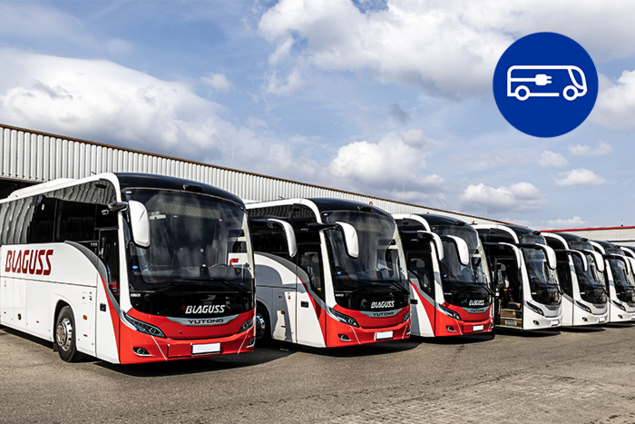
Discover our new electric coaches today!
Travel electric: Our electric fleet takes you to your destination comfortably, safely and quietly.
Energy Efficiency Through Fuel-Efficient Driving
Our drivers make a difference every single day.
In addition to regular road safety training, BLAGUSS drivers also participate in dedicated fuel-efficient driving training programmes. These programmes focus on fuel-efficient and anticipatory driving techniques. The aim is to reduce energy and fuel consumption during daily operations through adapted driving behaviour, while ensuring a safe and comfortable travel experience for our passengers.
Because for us, modern mobility is not just about technology – it is also about the people who safely take our passengers to their destinations every day.